
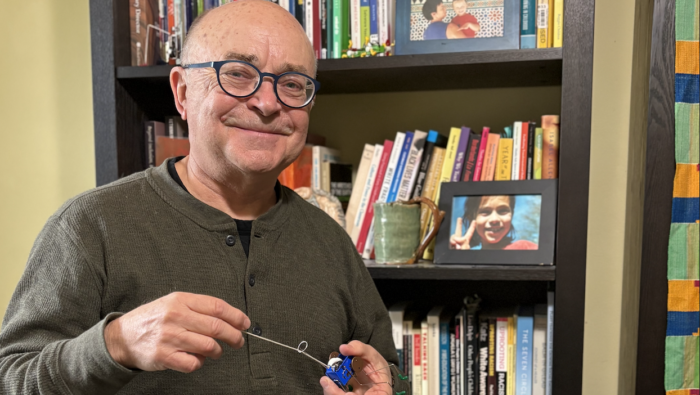
Photo: In his home office, John Nimmo holds a small mechanical object he has used in workshops with educators around the world. Participants are invited to study it, develop theories about how it works, and share their thinking: an invitation into inquiry, observation, and the co-construction of knowledge.
A Conversation with John Nimmo
In this conversation, educator and scholar John Nimmo reflects on more than fifty years in early childhood education. From his beginnings as a preschool teacher in Australia to his work as a professor and director of child development centers in the United States, Nimmo has helped shape conversations about inquiry, anti-bias education, community engagement, and the influence of the Reggio Emilia approach.
Gabriela Bizari and Emily McNeff sat down with John for this conversation, exploring the political roots of Reggio Emilia, the importance of cultural responsiveness in early childhood classrooms, and the role educators play in moments of social and political uncertainty.
Throughout the interview, Nimmo speaks about the intellectual life of teachers, the rights of children, and the importance of staying grounded in relationships with families and communities. What emerges is a powerful reminder: early childhood education is not only about care or preparation for school, it is about participation, belonging, and the shared construction of knowledge.
Interview
TPP:
Many people in the field are familiar with your work and your long contribution to early childhood education. But for readers who may be encountering your work for the first time, could you begin by introducing yourself and sharing a little about your journey into this field?
John Nimmo:
My name is John Nimmo, and I’m now a professor emeritus at Portland State University. “Emeritus” is a strange word, but it sounds better than retirement. I have really embraced the Spanish term of “jubilación”! I’m still engaged in many projects and conversations in the field.
My story in early childhood education goes back more than fifty years. I began in Australia, my home country, as a teacher working mostly with preschoolers and kindergartners. I worked with older children too, but very quickly early childhood became where my heart was.
I think I was attracted by the way children think and the way they see the world. I was talking recently with Louise Derman-Sparks about books, and I pulled out one of my oldest ones—Piaget’s The Child’s Conception of the World. The book is practically falling apart now. I remember reading it when I was about eighteen or nineteen and thinking how powerful Piaget’s interview method was. It was really about listening to children and being open to how they were constructing the world through their interactions with materials and with other people.
When I read that, I remember thinking, yes, that’s exactly how I see it.
In early childhood education, at least in Australia at that time, there was permission to recognize the intellectual lives of children. Their thinking was connected to their emotional worlds and their social worlds, and teachers were open to exploring how children made sense of things.
When I moved to the United States, I worked in childcare with infants, toddlers, and preschoolers. Eventually I became interested in working more with adults—supporting teachers, doing research, directing programs. That transition was significant.
Part of it came from wanting more time for reflection. As a classroom teacher, there often wasn’t enough time for the kind of intellectual engagement and collaboration that I felt I needed.
I’ve always believed strongly in the connection between theory and practice. Paulo Freire talks about praxis—the idea that theory and practice must exist together. You can’t think about what you’re doing in the classroom without thinking about how you understand learning, and theory doesn’t make sense if it isn’t connected to what actually happens with children.
TPP:
You mentioned theory and reflection, and that makes us think about the Reggio Emilia. You were also one of the people who introduced me to the Reggio Emilia approach. Could you talk about its origins and why it matters?
John Nimmo:
I was very fortunate in the way I encountered Reggio Emilia. At the time, the focus of my doctoral dissertation was around community—how teachers and children constructed ideas of community in different cultural contexts.
When I first went to Reggio Emilia, I was certainly struck by the environments, the art, and the documentation. There was an incredible use of media. I remember Vea Vecchi opening drawers filled with slide film cartridges of various exposure ratings —this was before everything was digitized. They had tape recorders everywhere.
The environments were beautiful. The art was beautiful. All of that communicated respect for children, for adults, and for families.
But what really captured my attention was the political context. Reggio Emilia emerged after World War II. The schools were founded by communities responding to fascism. Under fascism there was a very specific image of the child: children were expected to be compliant, to serve the state.
The founders of the Reggio schools had a very different image of the child. They saw children as citizens with rights—rights to contribute, rights to beautiful environments, rights to respectful education. This wasn’t a naive image. It recognized that children have knowledge and perspectives and ways of understanding the world.
The use of art and media was part of that. It allowed children to represent and explore their ideas, to share them with others, and to participate in civic life.
One of the most powerful things for me was seeing how connected the schools were to the city. Children collaborated with artists, contributed artwork throughout the city, and participated in civic projects. They had relationships with the mayor and other community members. That kind of participation was something I had never seen before.
TPP:
When you talk about the image of the child, it also raises the question of the image of the teacher. That’s something we often hear teachers struggle with today, the sense that early childhood teaching is undervalued.
John Nimmo:
Yes, I think that’s true. Alongside a strong image of the child, we need a strong image of the teacher.
Early childhood teaching is often undervalued because it’s seen primarily as caring work. It’s also largely done by women, particularly Women of Color, and poorly paid. All of that marginalization contributes to a lack of respect for the profession. Sometimes that lack of respect becomes internalized.
Teachers may begin to believe that their role is mostly about care and emotional support, and that theory belongs somewhere else.
But the educators in Reggio Emilia believed that teachers construct theory. Yes, we read Piaget, Dewey, Freire, Bronfenbrenner and others. We are also inspired by more recent thinkers like Mariana Souto-Manning and Gloria Ladson-Billings. But theory also emerges through practice. Through interactions with children and with each other, teachers develop ways of thinking about learning.
I’ve always resisted compliance as a teacher. I remember in my first year teaching in Australia an inspector came to observe my classroom.
I was outside playing with the children—crawling through tires in the outdoor environment. I came up out of the tires and looked up, and there was the inspector standing there with his notebook. I thought, this could go badly.
But he gave me a very positive report, because what he saw was children deeply engaged in their play. From early on I was interested in being present with children in their play—modeling care, participating in dramatic play, exploring alongside them.
TPP:
When Reggio Emilia became known in the United States, many educators were inspired by it. But often the focus landed on materials and environments. What do you think was misunderstood when the approach arrived here?
John Nimmo:
When Reggio Emilia became popular in the United States in the late 1980s, many people focused on the visible elements—the art, the materials, the environments. Those things matter, but they’re not the essence.
What was often missed was the political dimension. Reggio Emilia was fundamentally about democracy, participation, and children’s rights. Children were seen as contributors to civic life, not just learners inside classrooms.
TPP:
Many teachers right now feel discouraged. There’s political tension, uncertainty, and pressure on schools. How do you see early childhood education responding in moments like this?
John Nimmo:
For me, what we’re seeing right now has strong authoritarian elements, especially in the pushback against cultural responsiveness, inclusion, and diversity.
In moments like this, educators have choices. They can comply, or they can return to their core beliefs about children.
What is your image of the child?
Why are you doing this work?
What values guide your practice?
Those questions become especially important when funding is reduced or restrictions increase. At the same time, teachers are working with families who may feel very vulnerable. I was recently speaking with people at Latino Network, and they described families who had stayed inside their homes for weeks because they were afraid of immigration enforcement. So teachers are supporting families who are living with real fear. That makes relationships with families even more important.
TPP:
One thing we often notice is that programs sometimes try to replicate the look of Reggio Emilia—almost recreating northern Italy. How do you think educators should think about Reggio in relation to their own communities?
John Nimmo:
Yes, that’s something that has always frustrated me. I’ve walked into environments that look like northern Italy, and I think: that’s not the point.
Reggio Emilia is about context. I visited programs in Chicago Commons on the South Side of Chicago. In communities that were predominantly African American, the environments looked very different. In communities that were primarily Latinx, they looked different again.
That’s exactly what Reggio Emilia encourages—reflecting the community where the school exists.
One thing those schools did was what we might call community asset mapping. Teachers and parents would walk through the neighborhood taking photographs and documenting the assets in the community. These were marginalized neighborhoods often described in negative terms—poverty, violence. But when teachers and families documented the community, they found barbershops, community leaders, cultural traditions, businesses. Those photos were displayed in the school so families saw their community reflected and valued.
TPP:
What are some ways teachers can build stronger connections with families?
John Nimmo:
Families are one of the most important entry points. At the child development center I directed, we had families who spoke twenty-two different languages. Most adults spoke English, but English was the only language we were hearing in the school.
So we made some explicit changes. We purchased books in the languages of every child in each classroom. We invited parents to read stories in their languages. Over time we began hearing conversations in many languages among children and adults. The message was simple: your language is welcome here.
TPP:
You’ve spent many years mentoring teachers. What approaches have you found most helpful when supporting educators?
John Nimmo:
I’ve never found it useful to focus on what teachers are doing wrong. Instead I focus on what’s working.
I might record a small video of children engaged in something interesting and then talk with the teacher about what we’re seeing.
What strategies did you use?
What do you think the child is exploring here?
Those conversations help teachers reflect on their own thinking. Every teacher carries an image of what school looks like based on their own experiences. Expanding that image takes time.
TPP:
You often talk about questions and inquiry. What does that look like in practice?
John Nimmo:
I think one important distinction is between asking questions and wondering alongside children.
There are descriptive questions that have answers, but there are also questions that open possibilities. Sometimes the most powerful thing is simply wondering together with children.
I recently watched my grandson spend a long time trying to figure out how a small mechanical object worked—studying the gears, turning it over, exploring it. It reminded me of an activity I used with teachers in workshops. I would give them a small mechanical object and ask them to develop a theory about how it worked without taking it apart.
Adults would spend a long time observing, drawing, discussing their ideas. It was exactly the same kind of inquiry children engage in.
TPP:
As we wrap up, what message would you leave with educators working with young children today?
John Nimmo:
Don’t give up. When things feel overwhelming, return to the children.
Children didn’t create the world they’re growing up in. They can participate in it and help us understand it, but they’re not responsible for it. In anti-bias education we talk about identity, diversity, justice, and activism.
Children should have opportunities to explore identity and fairness, and to act in meaningful ways. But adult activism is our responsibility. We need to advocate for children, talk with legislators, support families, and defend policies that support early childhood education.
And perhaps most importantly, we introduce children to the world – and see us model activism.
We walk through neighborhoods. We meet people. We learn names. We hear different languages. Those everyday relationships help children understand that they are part of a larger community.
That’s where education begins.
Read more from John here:
Nurturing the Spirit to Teach: Commitment, Community, and Emergent Curriculum
Collaboration, Conflict, and Change: Thoughts on Education as Provocation


