
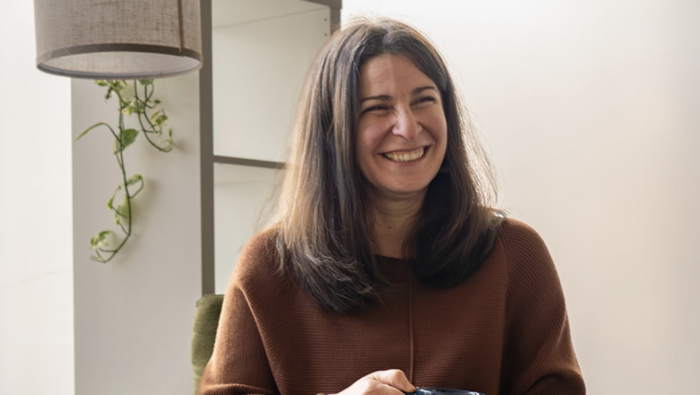
A Conversation with Katie Statman-Weil
In this conversation, therapist, educator, and author Katie Statman-Weil reflects on her work at the intersection of early childhood education, mental health, and family support. With experience as a preschool teacher, program director, adjunct professor, and licensed clinical social worker, Katie brings a deeply relational lens to understanding children’s behavior, development, and well-being. She currently works as a therapist supporting parents, and also leads workshops for educators and consults with schools.
Erin Moulton sat down with Katie for this conversation, exploring what it means to create trauma-responsive classrooms, how educators can support themselves in moments of stress, and the role of attunement, rhythm, and environment in shaping children’s experiences. Together, they reflect on the importance of understanding the nervous system, building supportive networks, and staying grounded in both self-awareness and connection.
Throughout the interview, Katie speaks to the power of small, intentional moments—of joy, play, and being seen—as essential experiences that children carry with them. What emerges is a thoughtful and reassuring perspective: educators do not need to have all the answers, but rather to remain curious, responsive, and connected to themselves, to each other, and to the children in their care.
We are honored to welcome Katie Statman-Weil as a keynote speaker at our Early Learning Conference on June 23rd at Gladstone’s Center for Children and Families, where she will continue to expand on these ideas with our community.
At the end of the interview, you’ll also find a collection of Katie’s recommended resources and books for further exploration.
Interview
Erin Moulton (TPP): Hi, Katie. I’m so glad you’re here talking with us today. I’m wondering if you would start by introducing yourself and telling us a little bit about who you are and what you do.
Katie Statman-Weil: Sure. My name is Katie Statman-Weil, and I’m both a licensed clinical social worker and an educator, so I’ve worn a lot of different hats over the years. I’ve been a preschool teacher, the executive director of an early childhood education and family support center, and I taught as an adjunct at Portland State for a long time. I also have another side of my work, I’m a therapist. I’ve worked with children and families, and now I primarily work with parents who are navigating challenges in their parenting, which is often what brings them into therapy.
I was also a foster parent for many years, and I’m now an adoptive parent through foster care. I have six children, ranging in age from 3 to 19. Many years ago, when I was getting my doctorate in education, I wrote an article about creating trauma-responsive classrooms, which later turned into a book. Thinking about how we support children who have experienced trauma has been a long-standing professional interest of mine, and now it’s also deeply personal. I’ve seen my own children—both those in my care and my adoptive children—move through the education system with nervous systems that are still growing and changing, and that have experienced loss, change, and stress.
Erin Moulton (TPP): It sounds like you have a wide variety of experiences with children and families from many perspectives—and that you’re a busy person. I’d love to hear: in the midst of all that you’re juggling, how do you support yourself, both with your own children and within your work?
Katie Statman-Weil: Yeah. You know, I really try to connect my experience of my body with my emotional experience and my cognitive experience. I think of it as a kind of cycle of checking in with all three parts, because it’s easy to focus on one and not the others.
Especially with an academic background in trauma—understanding what it looks like and how it shows up in children—it can leave me operating mostly in a cognitive space. But what I also know is that we have to pay attention to how things are impacting our own bodies. How do I feel in this moment? And how does that affect my ability to show up for my child—or for a child in a classroom—who is having a hard time?
So for me, one of the first steps is noticing what’s happening internally. Am I feeling fluttering in my chest? Tightness in my stomach? Are my shoulders hunched? That awareness helps me begin to shift—maybe I sit back, relax my shoulders, take a deep breath. It’s about figuring out, in each moment, what I need.
Over time, I also try to notice patterns—what helps me stay regulated. That’s part of the complexity and beauty of being human: our bodies tend to follow certain pathways when we’re stressed, but those pathways look a little different for each of us. So we have to figure out what works individually. Sometimes we’re given quick strategies—like a specific breathing technique that’s supposed to work for everyone—but if it doesn’t feel right, we won’t use it. And if we don’t use it, we won’t see the benefit. So it really matters that the strategy fits.
For me, walking is one of those things that works. The slow, steady movement helps me take in my surroundings, notice what’s happening around me, and reconnect with myself. It becomes a way to regulate and to practice breathing in a way that actually fits into my life. There are many strategies I use, but I think I always come back to this question: what am I already doing that’s working, and how can I build on that?
Erin Moulton (TPP): Instead of feeling like you have to add a whole new thing, it’s more like habit stacking—you’re making me think of that. Here’s something I already do—how can I do more with it, or deepen it?
Katie Statman-Weil: Yeah. What’s something that’s already happening that we love? Maybe it’s sipping coffee in the morning—holding the cup, noticing the warmth, the smell, the color of your favorite mug. All of these small moments can feel like magic, even though they’re not. They give our bodies a reminder of what it feels like to be in a peaceful, safe, and calm place—even if it’s just for a few minutes before we step back into the stress of the day.
Erin Moulton (TPP): Mm-hmm, yeah. You’re making me think about a time when I was really busy coaching—going from classroom to classroom, driving between school buildings—and I would walk in already feeling rushed or dysregulated. I started to notice that when I entered a classroom like that, teachers were also dysregulated and looking to me to help co-regulate with them.
It took me a while to get there, but I created a small practice: every time I put my hand on the doorknob, before I opened the door, I would take a deep breath and ask myself, Why am I here? Who am I showing up for? Because I realized I was bringing that stress in with me—and it was compounding what was already in the room. So it’s interesting to think about the things we’re already doing, and how we can slow down or pause, even for a moment…
Katie Statman-Weil: Yeah, absolutely. I think sometimes it’s about noticing the moments we already have. For example, if you’re driving and you stop at a red light, you know you have 20 seconds. Can you do a quick body scan? If you tend to hold tension in a certain place—maybe your jaw or your shoulders—can you check in and release some of that?
It’s about noticing those tiny shifts in our bodies. Often, we think of stress as the big moments at the end of the day—when we feel completely depleted, like we can’t even make dinner and just collapse into bed. But really, stress builds in all of these small moments along the way. If we’re not checking in, we keep escalating, little by little. But if we can build a regular practice of noticing—pulling our shoulders back, releasing tension in our stomach or legs—we can bring ourselves down just enough to create more capacity for whatever is coming next.
Erin Moulton (TPP): In that, I hear you describing how you’ve built supports into your daily life. I’m wondering—are there other things you turn to? Sources of inspiration, people, books… where have you gotten your tools and ideas?
Katie Statman-Weil: Hmm… I love learning, so I’m always looking for new perspectives and ideas—ways to understand what’s happening in a classroom or with a specific child. At this point, though, I find myself most interested in the lived experiences of individuals in classrooms, and of parents sending their children into those spaces. Beyond a foundational understanding of typical development and what stress can look like in children, so much of the work feels rooted in the individual—and in the relationships they’re part of. That sense of attunement can either support or hinder what’s happening. One program I really love is Circle of Security. It’s a parenting program focused on attachment, and it’s also beginning to be used more in classrooms. What I appreciate most about it is that it centers how we show up. How do we create space for children to explore, while also offering comfort when things go wrong?
There aren’t rigid “right” or “wrong” ways to do it—no prescribed scripts. And that feels really important to me. It allows each family, teacher, or community to adapt it in a way that feels authentic, rather than being told, “This is how you communicate respect,” or “This is what you say when a child is hurt.”
Instead, it’s about paying attention to the child in front of you. What are they communicating? How are they communicating it? And how can we respond to their specific needs? When I’m looking for support—whether I’m feeling stuck, confused, or something isn’t going well—I turn to other educators, therapists, and parents. People I can think alongside. Because so much of this work involves making informed guesses based on what we see, and then trying different approaches. I don’t have all the strategies myself, so I rely on the collective knowledge and experience of others.
Erin Moulton (TPP): I hear you saying it’s about finding thought partners—people to bounce ideas off of, to invite in and observe, to ask, What do you notice? But I also hear you saying that you turn to the children themselves—to learn from them and listen to them—that they’re part of what helps you when you feel stuck or unsure.
Katie Statman-Weil: Yeah, absolutely. It’s about noticing all the ways children are communicating through whatever is happening.
When I think back to when I first started in the classroom, we often separated things into silos—speech, sensory systems, mental health, academics—and treated them as very distinct areas. Now, I really see how interconnected they all are. For example, when a space gets loud, what happens to a child’s language? How does it shift as their sensory system becomes activated or overwhelmed? In contrast, how might their language be more available and clear in a quieter setting, with fewer children?
When we start to see those connections, we can begin to think about strategies that respond to the whole child. It allows us to create environments that are more supportive and responsive. I also really value learning from other disciplines. I love watching how speech pathologists and occupational therapists use different tools—those small, thoughtful strategies that, over time, build into something much bigger. There’s so much to learn there, and honestly, a lot of joy in those small, intentional moments.
Erin Moulton (TPP): I so agree. I love when the speech pathologist or occupational therapist shows up—I get so many ideas from them. Sometimes I’ll be feeling dysregulated by something a child is doing, and they’ll completely flip my perspective. I’ve always really valued that—it’s so fun.
So, you’ve already talked a lot about taking care of yourself and the strategies you use in the moment. What I hear most often from teachers is: What do I do in the moment? When a child is having a big reaction—refusing, running away, escalating—those are the times when teachers feel their own lids flip. I’d love to hear your thoughts on that.
Katie Statman-Weil: Yeah, I think about this in a couple of ways. One piece is more of a broader idea that has been really helpful for me. It comes from an older article—I believe from National Association for the Education of Young Children—where a kindergarten teacher talked about how people would always say, “You have so much patience.” And her response was, “I don’t have more patience—I just understand child development.”
That really stayed with me. The more I understand how trauma impacts the body, the less activated I feel in response to it. And I want to say that alongside the fact that this isn’t everything—it doesn’t mean that if you do get activated, you just need to learn more. But for me, this understanding is a big piece.
It helps shift the lens. Instead of thinking, This child is refusing because they don’t like me or I’m doing something wrong, I can recognize that their nervous system is being activated by something I haven’t fully understood yet. When I slow down and begin to ask, What is actually overwhelming or triggering for this child?—that’s when things start to shift. Over time, many of those bigger behaviors either lessen, become more predictable, or we’re able to plan for them. A lot of this comes down to understanding how our bodies respond under stress. Some of those responses make perfect sense in truly overwhelming or unsafe situations—but then they become patterns that show up even when the environment isn’t actually dangerous.
So in the moment, part of the work is reframing: This isn’t about me. Something is happening for this child. Even if they’re yelling, throwing things, or trying to run away, I can hold onto the idea that they’re overwhelmed—and I can be the person who helps bring things back to a place of regulation. The other piece is being honest with ourselves. There are moments when we feel overwhelmed, and it’s important to acknowledge that. To ask for support, to switch with someone if we can, to take a moment.
I think there’s often a pressure to be the kind of educator who never gets overwhelmed, who can always hold it together—but that’s not realistic. It’s actually quite vulnerable to say, This is hard for me right now. So having people we can turn to and talk things through with is really important. And then there’s the internal piece—being able to notice what’s happening in our own bodies. Often, our bodies signal stress before we’re fully aware of it. It takes practice to tune into that: Why does my chest feel tight? Why am I feeling anxious right now?
That awareness helps us respond more intentionally in the moment. And over time, it also helps us notice patterns. If there’s a particular time of day that consistently feels overwhelming, we can begin to ask: What needs to shift? What isn’t working for me here? So there’s this ongoing process of checking in—with ourselves, with the environment, and with the child—to understand what’s working, what isn’t, and what we might need to change.
Erin Moulton (TPP): It’s interesting—I feel like I hear you naming two things. There’s how you respond in the moment, and then there’s the self-work that happens before you even get there. There’s so much about getting in touch with yourself, and also about having a supportive network—people you can be honest with, people you can swap out with—so you don’t have to be everything for every child.
That feels really powerful. As you think about all of this, is there a message you have for educators right now? Especially in this particular moment we’re living in—the way the world is impacting both children and the adults around them?
Katie Statman-Weil: Yeah. I think about this a lot. Therapy and classrooms are very different spaces, but something they share is the possibility of these really meaningful moments—moments of calm, joy, peacefulness, and contentment. Moments that remind our bodies, this is possible.
When I think about classrooms, especially for children and families who are experiencing stress, uncertainty, or worry, I keep coming back to the importance of these small moments. They act as reminders—to children’s bodies and to our own—that joy is possible, that connection is possible. To be seen, to be understood, to feel someone delight in you—those experiences matter deeply. They are what children carry with them. When a child knows what that feels like in their body and emotionally, they begin to expect it. They begin to look for it, even when other parts of their life feel stressful or uncertain. And that doesn’t mean everything has to be calm or regulated all the time. It just means that those moments exist.
So when I think about what classrooms can offer, I think about these small, intentional experiences—moments of joy, connection, and play—where other stressors can fall to the side, even briefly. Especially in play, we see how important it is to be able to let go of everything else and simply be present. And in those moments, we’re offering something really meaningful. It’s a quiet but powerful way of reminding children: this is something you deserve. You deserve to feel this way.
Erin Moulton (TPP): That’s so powerful—thank you. I was ready to end there, but I have one more question. Given your breadth of experience with children—in classrooms and in your practice—do you have insight into the environments or conditions that help create those moments of joy you described?
Katie Statman-Weil: Oh, so many things. I think, first, it comes back to attunement—really knowing the children in our classrooms and their families. How do we bring them into the space? How do we show that we value who they are? That sense of being seen and appreciated is foundational. Another important piece is creating a strong and predictable rhythm. When children are living in environments that may feel stressful or uncertain, having a classroom where they know what to expect can be incredibly grounding. It helps them feel competent and secure.
I once led a workshop on trauma-responsive environments, and someone said, “So what you’re really saying is the environment is the third regulator.” And I thought—that’s exactly it. The environment itself can help regulate children when it’s consistent and predictable. There are small, practical ways to support that. For example, I love the idea of having photos of the children who are already in the classroom posted on the door. During drop-off, when a child arrives, they can see who is already there. It gives them a sense of what to expect before they even walk in—similar to that moment you described of pausing at the door and taking a breath.
These kinds of details help children feel oriented. They know what will happen first, what comes next, and how the day will unfold. And when most things feel predictable, it actually creates more space for children to process the unexpected. They can recognize, Oh, that felt different, because the rest of their experience feels steady. This predictability also helps teachers. When there’s a consistent rhythm, it becomes easier to notice patterns. If something isn’t working every day around the same time, that gives us information—we can look at what’s happening before and after, instead of constantly reacting in the moment. All of this creates a more supportive environment—for children and for adults—and makes the work feel more manageable.
Erin Moulton (TPP): That’s all so helpful and inspiring. Thank you so much, Katie. We’re looking forward to continuing this conversation on June 23rd at the Teaching Preschool Partners and Gladstone’s Center for Children and Families 3rd Early Learning Conference. We’re so thrilled to have you as our keynote speaker!
You can find more about Katie’s work here: With Connection PDX
Katie’s book: Trauma-Responsive Strategies for Early Childhood
Recommended Resources:
- Dr. Mona Delahooke: https://monadelahooke.com/
- Dr. Ross Greene: https://
livesinthebalance.org/ - Circle of Security Classroom: https://www.
circleofsecurityinternational. com/pages/cos-classroom - Dr. Walter Gilliam: https://
buffettinstitute.nebraska.edu/ about-us/our-people/walter-s- gilliam - Zero to Three: https://www.
zerotothree.org/
Recommended Books about Trauma:
- My Grandmother’s Hands: Racialized Trauma and the Pathway to Mending our Hearts and Bodies, by Resmaa Menakem
- The Body Keeps the Score: Brain, Mind, and Body in the Healing of Trauma by Bessel Van der Kolk
- What My Bones Know: A Memoir of Healing from Complex Trauma, by Stephanie Foo
- What Happened to You? Conversations on Trauma, Resilience, and Healing, by Dr. Bruce Perry and Oprah Winfrey


